Short answer
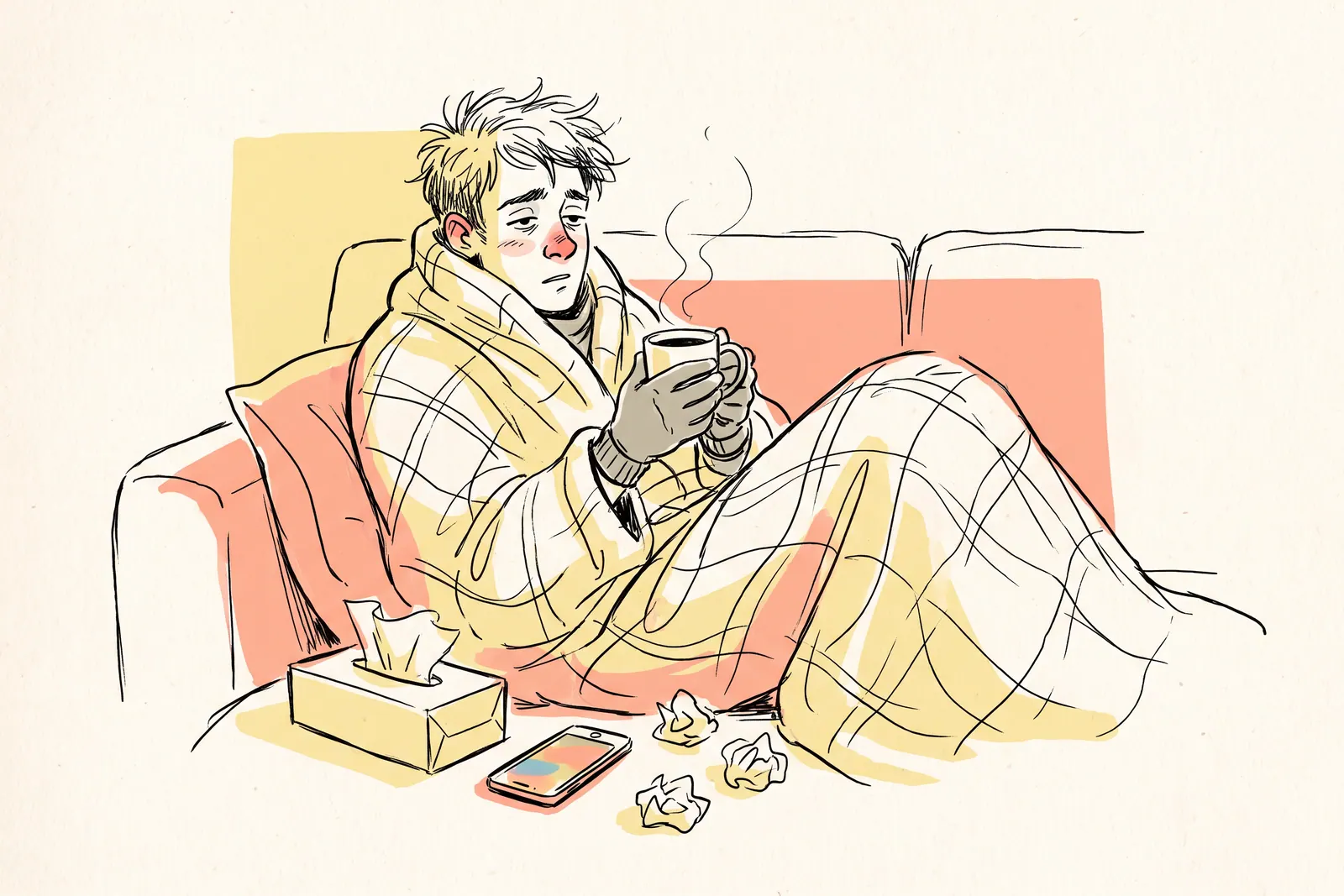
A cold with fever, exhaustion or a heavy cough can justify a sick note, and a video consultation is enough to assess it. At OpenClinic24 you describe your symptoms, a doctor assesses them by video and issues a private sick note (Arbeitsunfähigkeitsbescheinigung) as a PDF for at most three calendar days if you are unfit for work. The doctor always makes the decision.
Key facts
 German law requires a medical certificate by the fourth calendar day of illness at the latest (section 5 EntgFG); employers may demand it from day one.
 A cold usually lasts 7 to 10 days; symptoms peak on days 2 and 3, and most people are unfit for work for 2 to 5 days.
 By video, the private certificate from OpenClinic24 covers at most three calendar days, usually from the day of the consultation; backdating is possible only exceptionally after medical assessment, an extension by video is not.
 The reservation is €10.72 (GOÄ no. 1, factor 2.3); statutory health insurers generally do not reimburse private medical services.
 Fever above 39 °C, shortness of breath or symptoms lasting longer than ten days belong in a practice, not in a video consultation.
A cold and the sick note: what German law requires
A cold is the most common reason for short absences in Germany, yet many people are unsure when a certificate is needed. The Continued Remuneration Act (Entgeltfortzahlungsgesetz, EntgFG) sets two duties. You must inform your employer of your incapacity without delay, meaning on the first day before work starts. And you must present a medical certificate by the fourth calendar day at the latest if the illness lasts longer than three days (section 5(1) EntgFG).
Your employer may demand the certificate earlier, even from the first day of illness. This is often written into employment or collective agreements or ordered after repeated short absences. If in doubt, ask your HR department or read your contract. Many employees therefore get a sick note from day one as a precaution, even though the law only requires it from day four.
Important: a sick note (Arbeitsunfähigkeitsbescheinigung, AU) is a medical prognosis, not a ban on working. If you feel fit again before it expires you may return to work and simply inform your employer. German law has no concept of being signed back on.
As of October 2026: the federal government has announced a reform of the notification rules, including a certificate from the first day. No draft bill existed when this article was published. We will update this section as soon as the legal position changes.
How long does a cold last, and how long are you unfit for work?
A cold, medically an acute viral rhinopharyngitis, follows a typical pattern. After one to three days of incubation it begins with a scratchy throat and sneezing, followed by a runny and blocked nose, cough and often a mild fever. Symptoms peak after two to three days and subside within seven to ten days. A dry cough can linger for up to three weeks without being a sign of anything serious.
You are not unfit for work for the whole infection, only for as long as fever, exhaustion, headache, muscle pain or heavy coughing make work impossible or you would infect others. In practice that is usually two to five days. Anyone doing physical work, handling food or working in care needs longer than someone in an office or working from home.
| Phase | Timing | Typical symptoms | Fit for work? |
|---|---|---|---|
| Onset | Day 1 | Scratchy throat, sneezing, chills | often yes, not with fever |
| Peak | Days 2 to 3 | Runny nose, cough, head pressure, mild fever, exhaustion | usually no |
| Subsiding | Days 4 to 7 | Thicker nasal discharge, cough loosens | increasingly yes |
| Tail | Up to day 10, cough up to 3 weeks | Dry cough, tiredness | yes |
These are reference values from the literature on the course of the common cold. Your personal duration depends on the virus, your condition and your job. That is why the length of the sick note is set not by a calendar but by the doctor’s assessment in the consultation.
Medical assessment by video
Describe your cold symptoms and a doctor will see you by video. You receive the sick note as a PDF if you are unfit for work.
Request a sick note onlineSick note for a cold by video: how it works at OpenClinic24
A cold is well suited to a video consultation. The doctor sees you, hears your cough and asks about fever, duration, pre-existing conditions and your job. A physical examination rarely adds information for an uncomplicated infection, while skipping the waiting room avoids infecting others.
- Describe your concern. Choose “sick note” and answer a few questions about symptoms, onset, fever and pre-existing conditions. This is possible around the clock.
- Account and reservation. Create a patient account and add a payment method. €10.72 is reserved, the consultation fee under GOÄ no. 1 at factor 2.3. Nothing is charged until after the consultation.
- Video consultation. As soon as a doctor is online, the consultation starts. Have your thermometer, medication list and questions ready.
- Certificate as PDF. If you are unfit for work, the private certificate appears in your account: one copy for your employer without diagnosis and one for you, plus the GOÄ invoice listing every item.
The limits are clear. The certificate covers at most three calendar days and usually starts on the day of the video consultation. Backdating is possible only exceptionally after medical assessment, an extension by video is not. It is a private medical certificate as a PDF, not an electronic sick note (eAU); nothing is sent to your health insurer. Whether it is issued is decided solely by the treating doctor. There is no entitlement to a sick note, not even for a cold.
Cold, flu or something else: what the doctor looks for
Not every airway infection is a harmless cold. In the video consultation the doctor therefore clarifies three questions: does the picture fit a cold, are there signs of influenza or a bacterial complication, and are there warning signs that require an in-person examination?
Cold: gradual onset, runny nose and sore throat dominate, fever usually below 38.5 °C, general condition only moderately affected.
Influenza: sudden onset within a few hours, high fever from 38.5 °C, chills, severe headache and muscle pain, dry cough, marked weakness. Flu lasts longer and incapacity often five to seven days. For risk groups antiviral treatment can be useful if started within 48 hours; a practice is usually the right place for that.
Bacterial complications: sinusitis, tonsillitis with pus or bronchitis with a second fever peak can follow a cold. The typical sign is worsening after initial improvement. An examination of the throat, ears and lungs is then indicated.
Allergy: watery, itchy eyes, sneezing fits, clear nasal discharge without fever or muscle pain point to hay fever or a dust mite allergy rather than an infection.
What helps with a cold and what does not
There is no medicine against the viruses themselves; the body clears the cold. Treatment targets the symptoms so that you can sleep, drink and breathe. Rest, plenty of fluids, steam inhalation, decongestant nasal sprays for no more than seven days, lozenges or gargling for a sore throat and, if needed, fever-reducing painkillers such as paracetamol or ibuprofen according to the leaflet are well established.
Antibiotics do not help with a viral cold and, according to the guideline of the German College of General Practitioners, are only useful for a proven bacterial infection. Cough suppressants and expectorants have limited benefit according to the acute cough guideline; if you want to try them, do not combine them. Vitamin C and zinc shorten a cold by less than a day at most.
If you take regular medication, for example for blood pressure, blood thinning or diabetes, discuss interactions with over-the-counter cold remedies in the consultation. That is one more reason to use the video consultation not only for the certificate but also to ask what you can safely take.
When to go to a practice, when to call emergency services
The video consultation does not replace an in-person examination when findings need to be gathered. Go to a practice if fever lasts more than three days, with purulent sputum and breathlessness, earache with hearing loss, difficulty swallowing with pus on the tonsils, symptoms lasting longer than ten days or worsening after improvement. Pregnant women, people over 65 and people with chronic heart or lung disease, diabetes or a weakened immune system should be examined early when feverish.
Call 112 for shortness of breath, chest pain, impaired consciousness, seizures or fever with a stiff neck and rash. The medical on-call service is available nationwide on 116 117, including at night and at weekends.
Practical tips for when you are ill
Report sick on the first day before work starts, by phone or e-mail as your company requires. Note when symptoms began, your temperature readings and the medication you have taken; this makes the video consultation shorter and the assessment more accurate. Submit the employer copy of the certificate immediately. If you are still ill on the last certified day, have yourself reassessed by the next working day at the latest so that no gap arises; after a video certificate a practice is usually responsible for this.
And stay at home as long as you have a fever or a heavy cough. That protects colleagues and shortens your own illness.
When you need help immediately
- Shortness of breath, breathlessness at rest or pain when breathing
- Fever above 39.5 °C that does not respond to medication, or fever lasting longer than three days
- Severe headache with a stiff neck, sensitivity to light or confusion
- Symptoms that are no better after ten days or clearly worsen after initial improvement
- A cold with a known heart, lung or immune condition and rapid deterioration
With these warning signs call the emergency number 112. Outside office hours the medical on-call service is available on 116 117. In these situations a video consultation does not replace an in-person examination.
Sources
- Section 5 Entgeltfortzahlungsgesetz (EntgFG): duties to notify and to provide evidence. Federal Ministry of Justice, gesetze-im-internet.de, 2026. Law
- Arbeitsunfähigkeits-Richtlinie (incapacity for work guideline) of the Federal Joint Committee, sections 4 and 5. Gemeinsamer Bundesausschuss (G-BA), 2024. Guideline
- The common cold. The Lancet, 2003. DOI: 10.1016/S0140-6736(03)12162-9 Review
- Understanding the symptoms of the common cold and influenza. The Lancet Infectious Diseases, 2005. DOI: 10.1016/S1473-3099(05)70270-X Review
- S3 guideline Acute and chronic cough (AWMF 053-013). German College of General Practitioners and Family Physicians (DEGAM), 2021. Guideline
- Common cold: course, treatment, when to see a doctor. IQWiG, gesundheitsinformation.de, 2024. Authority
- Influenza: RKI guide. Robert Koch Institute, 2025. Authority
All sources were retrieved during the medical review. Studies are linked by DOI; guidelines and laws in their current version.
Frequently Asked Questions
From which day do I need a sick note for a cold in Germany?
By law on the fourth calendar day of incapacity at the latest, so once you miss a fourth day in a row. Many employment contracts and employers require the certificate from the first day, which section 5 of the Continued Remuneration Act (Entgeltfortzahlungsgesetz) allows. Check your contract, report sick on day one and submit the certificate afterwards.
How long are you signed off for a cold?
Usually two to five days. What counts is not how long the cold lasts but how long fever, exhaustion, coughing and the risk of infecting others make work impossible. By video, OpenClinic24 certifies at most three calendar days at a first contact; if symptoms last longer, a new medical assessment is needed, often in a practice.
Can I get a sick note for a cold online?
Yes, if a doctor assesses your symptoms in a video consultation and finds you unfit for work. A certificate issued from a questionnaire alone, without any contact with a doctor, is not permitted and can have consequences under employment law. At OpenClinic24 a licensed doctor always speaks to you.
How do I tell a cold from the flu?
A cold starts gradually with a scratchy throat, runny nose and mild cough, and fever usually stays below 38.5 °C. Influenza starts suddenly with high fever, chills, severe headache and muscle pain and marked weakness. If you suspect flu, have a high fever or breathing problems, an in-person examination makes sense.
Does the sick note start on the day of the video call or when symptoms began?
At OpenClinic24 usually on the day of the video consultation. Backdating by up to three days is possible only exceptionally after careful medical assessment. Get in touch on the first day of illness so that no gap arises. If you fall ill at the weekend you can submit your request at any time; the consultation takes place as soon as a doctor is online.
What does my employer see on the certificate?
Only the start and expected duration of the incapacity, the date of issue and whether it is a first or follow-up certificate. The diagnosis does not appear on the employer copy. You do not have to tell your employer the cause.
What does an online sick note for a cold cost?
OpenClinic24 works as a private practice under the German fee schedule for doctors (GOÄ). At booking €10.72 is reserved (GOÄ no. 1, factor 2.3); the certificate is billed under GOÄ no. 70. You see the total before confirming. Statutory health insurers generally do not reimburse private services.
May I go to work with a cold?
Legally yes; medically it is unwise with fever and marked weakness. Working while ill often prolongs recovery and infects colleagues. With a mild runny nose and no fever there is nothing against working, especially from home. A sick note is not a ban on working: if you feel well earlier you may return.

About the author
Note: This article provides general information and does not replace individual medical advice, diagnosis or treatment. If you have symptoms, contact a doctor; in an emergency call 112.